Month: February 2025

  • Foreign investments into Indian healthcare rose to USD 1.5 billion in 2024

    Foreign investments into Indian healthcare rose to USD 1.5 billion in 2024

    If everything falls into place, India’s healthcare sector could be in for a significant round of growth from new investments and favourable government policies find their mark.

    Over the last week, both the central budget announced by India’s Finance Minister Nirmala Sitharaman and the Kerala state budget placed special emphasis – and more important, government backing – to get more from medical tourism.

    It wasn’t just coincidence that healthcare sector and medical tourism found prominent mentions in both budgets. And more Indian states could be lining up their own policy shifts in attracting healthcare sector funding.

    According to Dr Azad Moopen, founder and Chairman of Aster DM healthcare, “For investors—both domestic and NRI—this moment presents a wealth of opportunities. The Indian government’s decision to ease visa norms for medical tourism is a game-changer, especially for a state such as Kerala.

    “India’s positioning as a global healthcare destination opens up vast potential for investment.”

    Dr Moopen’s India operations is going through a potential merger deal with Quality Care, a hospital operator with a sizeable presence in northern India.

    Sources say this year could see more GCC based institutional funding going into healthcare operators in India, even those who have their strengths outside of the metropolises. Andhra and Telangana are rated as high potential as are Uttar Pradesh and Maharashtra.

    Budget speak
    This is what Sitharaman had to say during the budget speech: “Medical tourism and ‘Heal in India’ (initiative) will be promoted in partnership with the private sector along with capacity building and easier visa norms.”

    As while presenting the 2025-26 Kerala budget, the state’s Finance Minister K. N. Balagopal confirmed plans to set aside up to Rs500 million in further expanding health tourism. “The (Kerala) state government will hold a global level campaign to feature the health tourism potential of Kerala,” he added, for good measure.

    Now, if these proposals turn into actual action plans, then India’s healthcare sector and allied areas could be in for a sustained growth run. “India can offer one of the most cost-effective medical consultations and hospital facilities in the world,” said the owner of a healthcare company in the Gulf. “There are GCC investors wanting to partner Indian companies to develop all such possibilities.

    “It’s good the Indian government is talking about developing medical tourism. If policies don’t come through, India will waste opportunities in healthcare.”

    Need more investments in Indian healthcare – and fast
    That sentiment about offering cost-effective services resonates loud.

    In 2024, foreign investments into Indian healthcare rose to $1.5 billion, with nearly half of this going into hospitals. This compares to 24% as healthcare FDI in FY21 and 43% in FY20.

    Plus, investors are getting their rewards from putting money into healthcare stocks.

    “These last 12 months, the Indian healthcare space has rewarded investors decently,” said Milan Vaishnav of ChartWizard. “While the NSE Healthcare Index has returned 20.81% over the past year, the BSE Healthcare index returned 23.95%.”

    Market sources say the $1.5 billion in foreign direct investment is just a glimpse of the kind of potential India’s healthcare sector offers. “There are existing hospitals that could do much better with new investments or global partners,” said an official with a healthcare fund operator.

    Kerala is well placed
    According to Dr Moopen, new policies such as easier visa processing will ‘strengthen Kerala’s position as a leading medical tourism hub while also boosting local businesses, hospitality, and allied services. “For Aster, which already caters to a large number of international patients, this is a significant opportunity to expand beyond Middle East and tap into new markets.” Gulf News

  • Punjab govt under Opposition fire for misusing Ayushman Bharat funds

    Punjab govt under Opposition fire for misusing Ayushman Bharat funds

    Leader of the Opposition (LoP) in the Punjab Assembly Partap Singh Bajwa on Thursday accused the Aam Aadmi Party-led Punjab Government of misusing funds under the Ayushman Bharat scheme.

    It has been more than four months since the Punjab and Haryana High Court asked the AAP Government to furnish details of the expenses incurred on advertising and purchase of new vehicles. However, the state government has failed to comply with the directions. The high Court was hearing a petition about the non-release of funds under the Ayushman Bharat scheme.

    “There are fair chances that the AAP Government misused the funds. Instead of clearing the dues of over Rs 500 crores of the private hospitals registered under the Ayushman Bharat scheme, the government misutilised the funds perhaps on other things, including advertisements, purchasing new vehicles and renovation of the houses of ministers and MLAs,” Bajwa added.

    Senior Congress Leader Bajwa said the private hospitals in the state suspended treatment of Ayushman card holders, claiming that their dues were not cleared by the state government.

    Under this scheme, cashless and paperless treatment is available at government and empanelled private hospitals. Initially, 16.65 lakh families were covered under the Union Government’s programme. But in 2022, the then Congress government decided to extend the scheme to families of farmers and those who were not covered under any health scheme, thereby adding 22.12 lakh more beneficiary families.

    “By not clearing the dues of hospitals, the AAP Government’s anti-poor face has been exposed. Meanwhile, the government is reluctant to provide details how the funds had been spent. The government seems to have a lot to hide,” Bajwa said. The Tribune

  • Chandan Healthcare launches IPO to mop up Rs 107.36 crore

    Chandan Healthcare launches IPO to mop up Rs 107.36 crore

    Chandan Healthcare Ltd. launched its public offer on Monday to mop up Rs 107.36 crore from investors in the primary markets. The company which operates diagnostic centres has branches located in multiple cities in North India. On the opening day of Chandan Healthcare SME IPO, here is what investors must know about the offer, price band, GMP and other details.

    Chandan Healthcare IPO: Key details
    The Chandan Healthcare IPO consists of a fresh issue of 44.52 lakh shares worth Rs 70.79 crore and an offer for sale of 23 lakh shares aggregating to Rs 36.57 crore.

    The NSE SME IPO will remain open for bidding from Feb. 10 to Feb. 12.

    Share allotment for the IPO is likely to be done on Thursday, Feb. 13. Successful bidders will receive credit of shares to their demat accounts on Friday, Feb 14, while refunds will be issued to the unsuccessful ones on the same day.

    Shares of Chandan Healthcare are likely to be listed on the NSE SME platform Emerge on Monday, Feb. 17.

    The company has reserved 50% of the net issue for qualified institutional buyers, 35% for retail investors and the remaining 15% for non-institutional investors.

    Chandan Healthcare IPO price band has been set at Rs 151 to Rs 159 per share. A single lot of the IPO comprises 800 shares, taking the minimum investment amount for retail investors to Rs 1,27,200.

    KFin Technologies Ltd. is the registrar for the Chandan Healthcare IPO, while Unistone Capital Pvt. has been appointed as its book-running lead manager. RK Stock Holding Pvt. is the market maker for the issue.

    Chandan Healthcare IPO: Day 1 subscription status
    Chandan Healthcare IPO has been subscribed 0.13 times as of 4:10 p.m. on Monday, as per market tracking site Chittorgarh:

    • Qualified Institutional Buyers: nil
    • Non-Institutional Investors: 0.07 times
    • Retail Investors: 0.24 times

    Chandan Healthcare IPO GMP today
    Chandan Healthcare IPO GMP (grey market premium) was Rs 10 apiece as of 2:37 p.m. on Feb. 10, according to InvestorGain. This indicates a listing gain of 6.29%, with the shares expected to debut on NSE SME at Rs 169 apiece given that the current trends are sustained. NDTV Profit

  • 1 in 5 mobile subscribers to use payment channel globally in 2025

    1 in 5 mobile subscribers to use payment channel globally in 2025

    A new study from Juniper Research, the foremost experts in the telecommunications market, has found that over 1.5 billion mobile subscribers will use carrier billing globally to buy either digital content, physical goods, or digital tickets, in 2025.

    However, it warns operators that if they wish to capitalise on this sizeable user base, they must maximise the attractiveness and value of the carrier billing opportunity to merchants by positioning their networks as distribution channels, rather than as mere payment facilitators.

    Carrier billing is a mobile payment method allowing users to make purchases by charging payments to their mobile phone bill.

    Operators Need to Become Content Distribution Channels
    A key market driver in carrier billing has been the adoption of a new API called ‘Check Out’ that emerged from the CAMARA project; an open-source framework that standardises APIs for telecoms networks.

    Whilst this has been key to increasing subscriber access to carrier billing, the report warns that deploying this API alone will not be enough to capitalise on the huge global carrier billing opportunity – with spend forecast to grow from $83 billion in 2025 to over $130 billion by 2029, according to Juniper Research.

    The report urges operators to transform their networks into distribution channels; enabling mobile subscribers to purchase digital subscriptions via an operator’s consumer-facing platform. Unlike established bundling, this strategy is underpinned by the integration of content management services; allowing operators to have a direct billing relationship with their subscribers for digital content. Operators must maximise these platforms through revenue share agreements with digital service providers to capitalise on the large user base. Juniper Research

  • India’s smartphone market grows 4% YoY in 2024

    India’s smartphone market grows 4% YoY in 2024

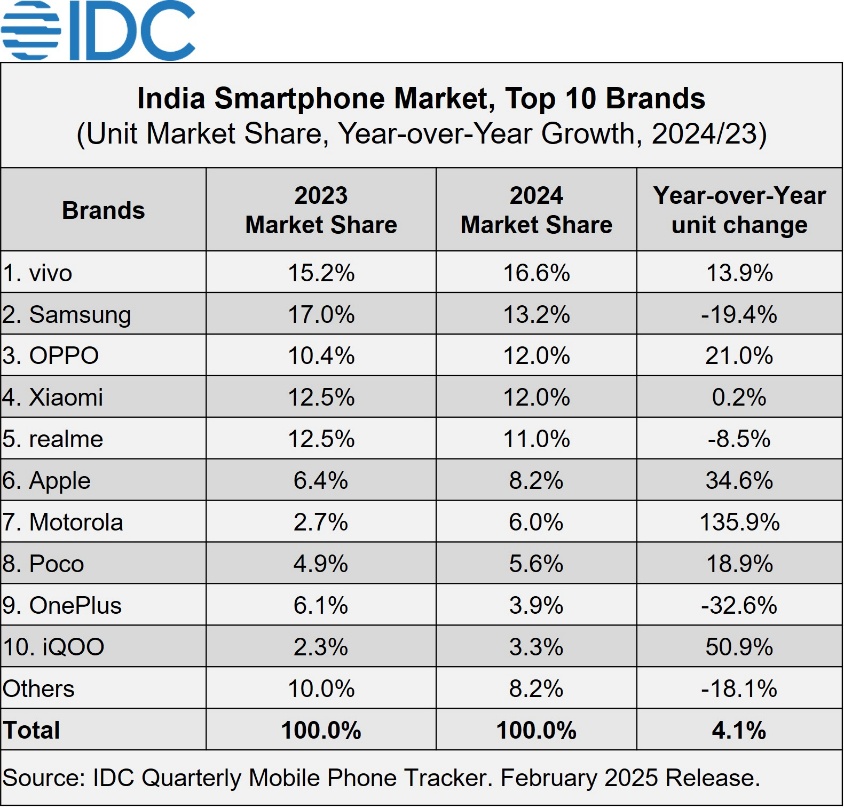
    India’s smartphone market grew 4% year-over-year (YoY), with shipments reaching 151 million, according to IDC.

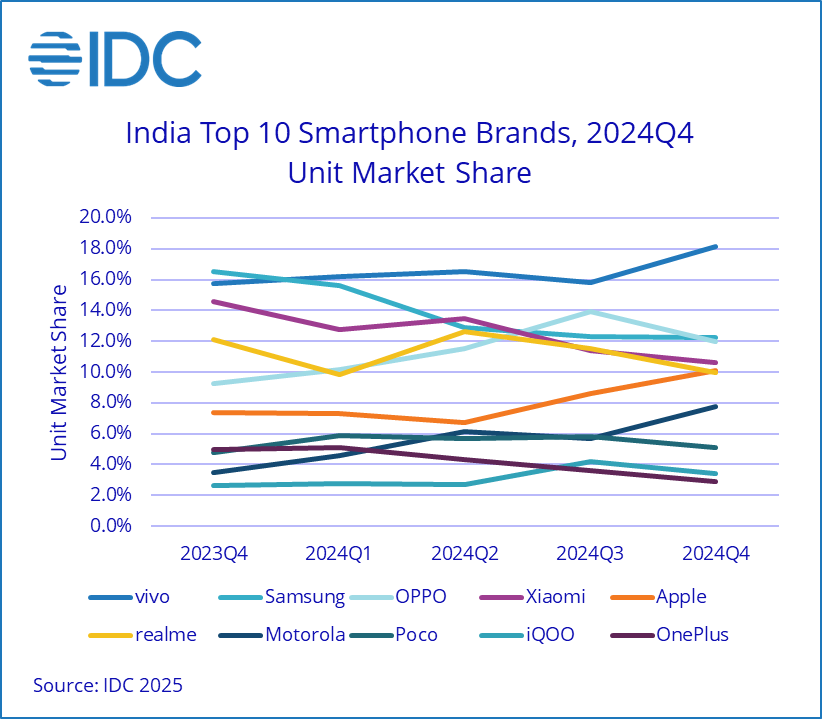
    India became the fourth largest market for Apple in 2024, after USA, China, and Japan, as shipments reached a record 12 million units in the country, with 35% YoY growth. In 4Q24, Apple entered the Top 5 brands in India for the first time with a 10% share. iPhone 15 and iPhone 13 were the highest shipped models, accounting for 6% of overall shipments during the quarter.

    “The vendors and channel partners continued to provide price cuts, discounts, and extended device warranties in the post-festive period in 4Q24. While financing options were available across price segments, its impact was more pronounced in mid-range and premium devices throughout the year, with the ‘No Cost EMIs’ for up to 24 months being most popular,” said Upasana Joshi, senior research manager, Devices Research, IDC Asia Pacific.

    Key Highlights for 2024:
    While the ASPs (average selling price) reached a new high of US$259 in 2024, the 2% YoY growth was significantly lower than the double-digit growth seen the previous three years. The entry-premium (US$200<US$400) segment registered the highest growth of 35.3% YoY, with a 28% share, up from 21% a year ago. The premium segment (US$600<US$800) grew 34.9%, with its share up to 4% from 3%. Key models were the iPhone 15/13/14, and Galaxy S23/S24. Apple and Samsung’s share increased in this segment, led by the previous generation models.

    120 million 5G smartphones were shipped in the year. The share of 5G smartphone shipments increased to 79%, up from 55% in 2023, while 5G smartphone ASPs declined by 19% YoY to US$303. Within 5G, shipments of the mass budget (US$100<US$200) segment almost doubled, reaching 47% share. Xiaomi Redmi 13C, Apple iPhone 15, vivo Y28, Apple iPhone 13, and vivo T3X were the most shipped 5G models in 2024.

    Shipments to offline and online channels grew almost at par by 4% YoY, and shares remained similar at 51% and 49%, respectively, in 2024. Samsung continued to lead in the online channel, while Apple climbed to the fourth position, with iPhone 15 as the highest shipped smartphone online. Within the offline channel, vivo maintained its dominance, while OPPO and Xiaomi climbed to the second and third spots, respectively.

    Overall, vivo surpassed Samsung for the leadership position in 2024, with its consistent omnichannel play, diversified portfolio across price segments and channel support. Nothing registered the highest growth overall, followed by Motorola and iQOO annually. The long tail of brands collectively gained ground in 2024, as the share of the top five vendors depleted from 76%, 68%, and 65% in 2022, 2023, and 2024 respectively.

    54 million feature phones were shipped annually, declining by 11% YoY. Transsion continued to lead with a 30% share, followed by Nokia and Lava. Overall, 205 million mobile phones were shipped, registering a 1% annual drop.

    “With a low single-digit growth in 2024, growth in 2025 hinges on a stronger performance in the mass segment (US$100<US$200) and more offerings in the entry-premium segment (US$200<US$400) for upgraders,” says Navkendar Singh, associate vice president, Devices Research, IDC India. “Generative AI features and use cases will start being key differentiators, moving beyond flagship models and becoming more prevalent across different price points. Online-focused long-tail brands will venture offline to sustain growth. However, the weakening rupee could impact ASPs, potentially restricting annual growth to below 5% in 2025.”


    IDC

  • Brazil denies plan to tax US tech firms over steel tariffs

    Brazil denies plan to tax US tech firms over steel tariffs

    Brazil’s finance minister rejected on Monday a report saying the country was planning to impose taxes on U.S. tech companies if President Donald Trump proceeds with plans to introduce a 25% tariff on all U.S. steel imports.

    “The information is not correct,” Fernando Haddad wrote on social media, after the newspaper Folha de S.Paulo reported that President Luiz Inacio Lula da Silva’s administration was mulling tariffs on big tech firms as retaliation.

    The South American country is one of the largest sources of U.S. steel imports as well as a top market for many big tech companies.

    Trump said on Sunday he would introduce on Monday new 25% tariffs on steel and aluminum imports, on top of existing metals duties, in another escalation of his trade policy shakeup.

    “The Brazilian government has made the sensible decision to only make statements at the appropriate time and based on concrete decisions, not on announcements that could be misinterpreted or revised,” Haddad said.

    According to the Folha report, which cited an unnamed Brazilian authority, a potential Brazilian levy could have affected Amazon, Meta Platforms’ Facebook and Instagram, and Alphabet-owned Google.

    A finance ministry official in 2024 had already floated the idea of a potential tax on big tech companies to meet fiscal targets in case there was a government revenue shortfall this year. Reuters

  • Tower Semiconductor expects Q1 2025 revenue to exceed estimates

    Tower Semiconductor expects Q1 2025 revenue to exceed estimates

    Israeli contract chipmaker Tower Semiconductor forecast first-quarter 2025 revenue slightly above estimates on Monday, on expectations of resilient demand for its chips from the automobile sector.

    The US-listed shares of the company were up 1 per cent in premarket trading.

    Tower makes analog and mixed-signal semiconductors used mainly in automobiles for “fabless” firms, which design chips but outsource their fabrication.

    Despite the automobile sector struggling to clear inventory since its excessive stockpiling during the pandemic, a trend exacerbated by a slowdown in demand for electric vehicles in the past year, Tower Semiconductor has been resilient in recent quarters and has continued to supply its chips.

    The chipmaker forecast first-quarter revenue of $358 million, with an upward or downward range of 5 per cent, slightly above analysts’ estimates of $357.5 million, according to data compiled by LSEG.

    Tower posted fourth-quarter revenue of $387.2 million, which was in-line with estimates.

    Net profit for the quarter ending December 31 was $55.1 million, below estimates of $58.7 million, due to taking on its portion of incremental costs of the greenfield chipmaking plant in Agrate, Italy.

    On an adjusted basis, the company reported quarterly profit of 59 cents per share, compared with analysts’ estimates of 52 cents per share. Reuters

  • Baidu CEO says more AI spend still needed despite DeepSeek’s success

    Baidu CEO says more AI spend still needed despite DeepSeek’s success

    Investment in data centres and cloud infrastructure is still needed despite DeepSeek challenging the cost efficiency of large AI models, Baidu CEO Robin Li said.

    “The investment in cloud infrastructure is still very much required. In order to come up with models that are smarter than everyone else, you have to use more compute,” Li told attendees at the World Government Summit in Dubai.

    Compute refers to the hardware resources that make AI models work, allowing them to train on data, process information, and generate predictions.

    Li’s comments come as Chinese AI startup DeepSeek has gained global attention for developing language models that match the performance of leading systems like OpenAI’s GPT while using significantly less computing power, raising questions about the necessity of massive AI infrastructure spending.

    Baidu was among the first Chinese companies to launch AI products following OpenAI’s ChatGPT release in late 2022. However, its large language model Ernie, which Baidu claims matches GPT-4’s capabilities, has seen limited public adoption.

    Li has made bold claims about China’s AI landscape in the past, including saying that it was unlikely that another OpenAI-like company would emerge from China. He had also advocated for closed-source models as the only viable path for AI development.

    At Tuesday’s summit, Li acknowledged that DeepSeek’s sudden emergence demonstrated the unpredictable nature of innovation.

    “You just don’t know when and where innovations come from,” he said.

    Li added that U.S. chip sanctions have forced Chinese companies to innovate within computing constraints.

    He also appeared to soften his stance on closed-source development, now acknowledging that open-source approaches could accelerate AI adoption.

    “If you open things up, a lot of people will be curious enough to try it. This will help spread the technology much faster.” Reuters

  • Expanding Broadband access in rural Northern California

    Expanding Broadband access in rural Northern California

    High-speed internet is becoming more accessible to rural communities in Plumas, Lassen, Sierra, and Modoc Counties, thanks to a $1 billion broadband expansion effort led by the California Public Utilities Commission (CPUC). This initiative, which spans 47 counties statewide, aims to bridge the digital divide by funding the deployment of reliable, high-quality, and affordable broadband infrastructure in underserved areas.

    The Federal Funding Account (FFA) and the Broadband Equity, Access, and Deployment (BEAD) program played a key role in securing resources for broadband expansion. As part of these efforts, 2 million Californians will benefit from new projects, ensuring that even the most remote communities have access to essential digital services.

    For rural areas like Plumas, Lassen, Sierra, and Modoc, where broadband access has historically been limited, these grants represent a transformative opportunity. The funding will be used to build new internet infrastructure, improve connectivity speeds, and support public partnerships to bring high-speed internet to homes, schools, and businesses.

    With broadband becoming increasingly essential for education, work, and emergency services, this investment marks a significant step forward in ensuring that rural Northern California is not left behind in the digital age. The CPUC is expected to oversee the implementation of these projects in 2024 and 2025, with a focus on reaching low-income and disadvantaged communities.

    For residents eager to learn more about how this initiative will impact their area, local broadband providers and community organizations will be sharing updates as projects develop. SierraDailyNews

  • Rostelecom reports Baltic Sea cable damage

    Rostelecom reports Baltic Sea cable damage

    Russia’s leading telecommunications provider, Rostelecom, has confirmed that one of its underwater cables in the Baltic Sea has been damaged due to external impact.

    “Rostelecom’s underwater cable was damaged in the Baltic Sea as a result of external influence,” the company said in a statement released for the media on Saturday. It added that services remain operational and that repairs are underway. Authorities have yet to determine the precise cause of the damage.

    Earlier the same day, the Finnish Coast Guard said it was overseeing the repair operation in Finland’s exclusive economic zone, where a Russian vessel is conducting the work.

    “The Gulf of Finland Coast Guard monitors compliance with the Economic Zone Act and the conditions for the use of the economic zone, where repair work on the damaged Russian cable is underway by a Russian vessel,” the agency wrote on X (formerly Twitter).

    Cable damage in the Baltic Sea has become more frequent, with Sweden, Norway, and Finland reporting similar incidents in recent months. Concerns have grown over the security of subsea energy and data infrastructure, though officials have not found definitive evidence of sabotage.

    NATO recently expanded surveillance operations following suspected sabotage, with speculation circulating that Russia could have played a role in the incidents.

    Earlier this month, Norwegian authorities cleared a Russian-crewed vessel after finding no evidence linking it to recent damage to an undersea fiber optic cable connecting Latvia and Sweden.

    The Norwegian-owned vessel, which operates between St. Petersburg and Murmansk, was detained in January following a request from Latvian authorities.

    The Kremlin has denied allegations of involvement in undersea cable damage, with spokesman Dmitry Peskov dismissing the accusations as baseless. “It is quite absurd to continue to blame Russia for everything without any reason,” he said. Big News Network